Showing posts with label Warner Bros. Pictures. Show all posts

Tuesday, January 1, 2019

SPACE JAM: Technical Foul

RETRO REVIEW


“We gotta get new agents. We’re getting screwed.”

- Daffy Duck (voice of Dee Bradley Baker), Space Jam

A long time ago... in the ‘90s... there was one athlete who could do no wrong. That gentleman was Chicago Bulls superstar Michael Jordan. The man took basketball to new heights of glory with his amazing skill and physicality. Naturally, everybody wants a piece of him and he became the most-promoted athlete of all time. He had endorsements for just about everything under the sun: men’s underwear, soft drinks, fast food hamburgers, hot dogs and, most famously, Air Jordan shoes.


One of these endorsements resulted in a popular Super Bowl commercial in which Jordan teams up in a basketball game with “Looney Tunes” star Bugs Bunny against Marvin the Martian. The spot was referred to as “Hare Jordan”. Jordan’s agent, David Falk, went to Warner Bros. Pictures (the corporate owners of the “Looney Tunes”) to convince them of the massively popular groundswell that this particular commercial generated. Desperate to generate their own Who Framed Roger Rabbit, the studio hired Ghostbusters director Ivan Reitman to produce the world’s first feature film inspired by a commercial.


The first thing Reitman did was hire the man behind the Super Bowl commercial, Joe Pytka. Pytka, a veteran of music videos and commercials, had directed only one other film prior: the Richard Dreyfuss gambling comedy Let It Ride. Reitman also contracted the animators it would take to bring this spectacle to life; rather than working at Warner Bros., the team found themselves at Universal where they had to endure the monotonous Jaws-themed tram tour stop right outside their door. As Roger Rabbit was the high watermark this new project was aiming for, Reitman called director Robert Zemeckis to ask his advice. Zemeckis replied, “Don’t do it. It nearly killed me.” Undeterred with the Academy Award-winner’s warning, Reitman hired the same visual effects supervisor of Roger Rabbit, Ed Jones, to do the same job for the film soon to be titled Space Jam.


The live-action portions of the film were shot first, bringing in real-life NBA stars and noted Chicago Bulls fan/Reitman alumni Bill Murray. The Looney Tune Land sequences where filmed with Jordan on a massive green screen stage working with actors in head-to-toe green onesies, playing the various Looney Tunes characters. In his contract, Jordan requested the studio build him his own basketball court near the soundstages, not only so he could practice for the film but also keep in shape for the upcoming NBA season. Of course, this drew a lot of attention at Warner Bros. and quite a few stars wanted to play against Jordan, most notably George Clooney.


This film was a huge gamble for Warner Bros., who were banking on both the likability of the world’s most famous athlete and the recognizability of their famed cartoon characters. An equation that included a relatively unknown director, a powerhouse producer, four (count ‘em, four) writers, Michael Jordan and the Looney Tunes. What could possibly go wrong?


In the underground world of “Looney Tune Land”, the most famous cartoon characters have a close encounter with the “Nerd” kind: the weak-willed and diminutive aliens Nerdlucks, who come to issue an ultimatum - come work for their boss Swackhammer (voice of Danny De Vito) at his outer-space theme park or else. While the Tunes take their threat seriously, they don’t take the aliens themselves seriously; taking off on their stature, Bugs and company challenge them to a basketball game. The Nerdlucks have never heard of basketball, let alone play it, so they go to Earth to secretly steal the talents of the NBA’s top players; inadvertently causing a national crisis. They return to the Tunes as oversized basketball-playing behemoths dubbed the Monstars. Deciding that the odds need to be made even, the Tunes literally rope in the greatest basketball player alive, Michael Jordan (naturally as himself). There’s just one problem: Jordan retired himself from the game and now spends his days as a middling minor-league baseball player. But ultimately, Michael becomes embedded in their cause and the battle to save the Looney Tunes takes to the court.
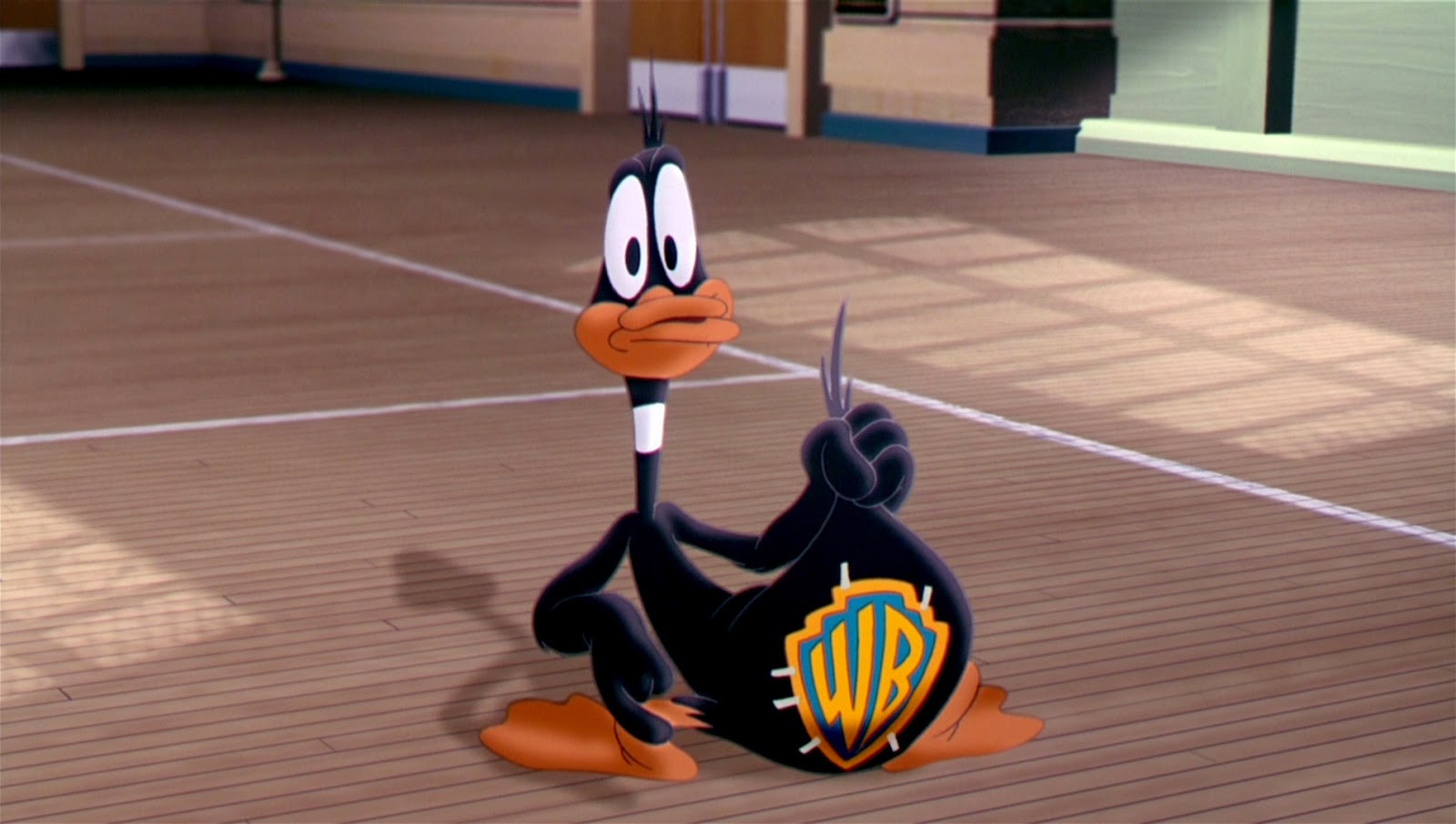

Because this movie came out in the mid-‘90s (not to be confused with the Jonah Hill film of the same name), more than a few people of my generation love this movie more than life itself. And I must admit as a kid, I too was taken with it to the point where I had a makeshift Tune Squad shirt. But as I grew older and immersed myself in the classic Looney Tunes cartoons of Chuck Jones, Friz Freleng and Robert McKimson, I came to a conclusion: this movie is bad. It is so remarkably cheesy and cynical; made purely to merchandise and capitalize. The unrelenting rabid fanbase cannot see past their own nostalgia and understand that this is not how these characters should be depicted. Even Chuck Jones himself said that his Porky Pig would never admit to public urination.


The weakest part of the whole film for me is the main voice cast. Understandably, the shoes of Mel Blanc are impossible to fill. Ever since his death, there has been a revolving door of actors to play the main Looney Tunes characters. The one actor who comes the closest is Mel’s own son, Noel, who assisted his father in his later years with voiceover sessions and ended up developing a fairly accurate mimicry of his father’s characters. Noel was asked to play the majority of his father’s characters in Space Jam, but ultimately was replaced due to contract negotiations stalling out. Billy West and Dee Bradley Baker were cast in the roles of Bugs and Daffy, respectively. These two guys are among the cream of the crop of modern-day voice actors and have done and continue to do great work. However, they are wildly miscast here. Their voices just do not fit these two particular characters and they are the two main leads of the Looney Tunes, so they get the lion’s share of screen time.


One negative element about the film that I would actually like to defend is the performance of Michael Jordan. When critics pick apart this movie, they often cite Jordan as a terrible actor. That is quite unfair as, obviously, Jordan is not an actor by trade. Not only that but the man is playing himself! Sir Lawrence Olivier could not play Michael Jordan if he tried. Having said that, one of Jordan’s co-stars might have been better suited for the lead: the legendary Bill Murray as himself. Putting one of the world’s funniest actors around the world’s funniest cartoon characters should be a no-brained but the movie only brings Murray to Looney Tune Land at the end. He is easily the best part of the whole film and even has the funniest line, explaining how he got to the game (“Producer’s a friend of mine...”).


Space Jam is less a movie and more of a time capsule of what the ‘90s were. It emodied the crass commercialism that had invaded pop culture. Its story is ludicrous, its characters wildly misrepresented and it relies way too heavily on close-ups. Famed director Joe Dante, a dyed in the wool Looney Tunes fanatic, was given the opportunity to bring the characters back to the silver screen with his 2003 film Looney Tunes: Back in Action. Unfortunately, that film was built on the back of previously developed Space Jam sequels (i.e. Race Jam with NASCAR driver Jeff Gordon and Spy Jam with Jackie Chan). Due to Warners prioritizing the Matrix sequels over Back in Action, the film was a dismal failure at the box office and Dante has not directed a studio film since. In more recent years, Warner Bros. has developing a direct sequel to Space Jam, this time with modern NBA superstar LeBron James. Black Panther director Ryan Coogler will be stepping into the producing role that Ivan Reitman had for the original film. All I can say regarding this sequel sight unseen is Coogler is a smart and talented filmmaker and he certainly cannot possibly make the movie worse than the original.

UPDATE:

Wednesday, May 9, 2018

SPEED RACER: No Limits

RETRO REVIEW

NOTE: Today is the 10th anniversary of Speed Racer.


"Racing hasn't changed and it never will."
"It doesn't matter if racing never changes. What matters is if we let racing change us. Every one of us has to find a reason to do this. You don't climb into a T-180 to be a driver. You do it because you're driven."

- Speed Racer (Emile Hirsch) and Racer X (Matthew Fox), Speed Racer

One of the first examples of anime to ever cross stateside to the US of A was the series "Mach GoGoGo", which was developed by Tatuso Yoshida. Combining the popularity of Elvis Presley with the gadgets of James Bond led to a high-octane hero who, with the help of his family and friends, set out to conquer the world of racing. When it was brought to the States, the series was given to Peter Fernandez to translate the show into English and find American voices for the shows characters. The lead character's name was changed to Speed Racer with Fernandez leading the voice cast. Many in the cast pulled multiple duties in voicing several characters: Fernandez was not just Speed, but also his long-lost older brother Rex Racer in disguise as Racer X; actress Corrine Orr was Speed's mother and younger brother Spritle and Speed's lovely girlfriend Trixie; actor Jack Grimes was Speed's loyal mechanic Sparky and Spritle's monkey companion Chim-Chim and rounding out the cast was Jack Curtis as both Speed's father Pops and local investigator Inspector Detector.


Fernandez was working around the clock, often delivering a complete redub of an episode within four days. The pay was not that great, but Fernandez and the rest of the cast were dedicated. Years later, the show was picked up by MTV alongside other anime shows like "Æon Flux". "Speed Racer" eventually became an indelible part of pop culture - many later cartoons parodied the often fast-paced intense conversations the characters would have (which was a result of the redub needing to get as much information across as quickly as possible with the footage that was given), the popular theme song (that was never credited with the actual musicians, Danny Davis and the Nashville Brass) and of course, the Mach 5 car. 


Naturally, Hollywood could not resist a film adaptation of "Speed Racer", but the road to movie-dom was covered in potholes. Many of Hollywood's top filmmakers today grew up watching the show on TV. Warner Bros. owned the rights to the series and several directors were contacted over the following years: Space Jam's Joe Pytka, Earth Girls are Easy's Julien Temple, My Own Private Idaho's Gus Van Sant (who later went on to the Oscar-winning Good Will Hunting and the reviled remake of Psycho) and A Little Princess' Alfonso Cuarón (who later went on to the Oscar-nominated Harry Potter and the Prisoner of Azkaban and the Oscar-winning Gravity). Several screenwriters were also hired and subsequently fired including J.J. Abrams who wrote a very hard-edged script that included a near sex scene with Speed. Ultimately, by the early 2000s, "Speed Racer" was still just a punch line to be mocked in things like a Geico commercial


This is how the Wachowskis appear in the video game "The Matrix: Path of Neo".

Enter the Wachowskis, hot off the mega franchise The Matrix. They re-teamed with Warner Bros. and producer Joel Silver to give "Speed Racer" a new lease on life. While seemingly a out-of-left-field choice to tackle a family-friendly project like Speed Racer, the Wachowskis had a motivation for taking on the project - they were looking to make a cubist film. By their own definition, a cubist film would be a "construction of art based on the imagination of perspective". When asked about the film years later, they said, "We knew that adults cannot accept challenges to their conventional aesthetic, the aesthetic that they are bonded to.... if you sort of assault that aesthetic they will really rage in this primitive way. So we thought maybe we can make it for kids because kids are much more open aesthetically than [adults] are." They brought the whole cast and crew to Germany to film in Studio Babelsberg. Rather than actually filming on location, nearly all of the sets were filmed with green-screen and actors driving shells of cars as opposed to actual cars. Doing this guaranteed the Wachowskis full control over the image (their first in high-definition) and would help to invent their vision of a live-action Speed Racer.


In the high-octane world of racing, there is nobody faster than Speed Racer (Emile Hirsch). Having grown up all his life with an uninhibited love of racing, he is supported by his racecar builder father Pops (John Goodman), his loving Mom (Susan Sarandon), his devoted girlfriend Trixie (Christina Ricci) and his younger brother Spritle (Paulie Litt). Speed is continually haunted by the death of his brother Rex (Scott Porter) during an extremely dangerous off-road rally. The Racer family is approached by billionaire E.P. Arnold Royalton (Roger Allam) who wants to sign Speed to his high-profile racing team. After showing the family around Royalton's massive corporation, Mom and Pops are immensely distrustful of him, but say the decision belongs with Speed and if he agrees, they will gladly follow in business. Believing that the spirit of racing belongs with the heart and not the bottom line, Speed politely declines. Royalton immediately reveals his true colors as a greedy megalomaniac and proceeds to tell him that if he will not race with him, he and his family will eventually be destroyed. Determined to prove Royalton wrong, Speed and his family reluctantly team up with the mysterious Racer X (Matthew Fox) and the cunning investigator Inspector Detector (Benno Fürmann). But Royalton will not be taken down easily as he has several of the dirtiest, most destructive racers on his payroll. To defeat them, Speed has to put the pedal to the metal and just go, go, go...


When I first saw the trailers, I was very, very impressed and wanted to know more about the show. I picked up the original series' first season on DVD and enjoyed it very much. When I finally got around to the movie... it did not work for me. (At first.) Among my complaints, I thought Emile Hirsch was way too old to play Speed and Spritle and Chim-Chim interrupted the action far too much than was necessary. One particularly terrible line is "Get that weak-ass shit off my track!" Really? Do we need that in a Speed Racer movie? A momentary use of "Free Bird" is out-of-nowhere. (Does Lynyrd Skynyrd exist in this world? It is clearly not our world.)


But little by little, viewing by viewing, I began to see more positives than negatives. I think that John Goodman and Susan Sarandon are perfectly cast and the screenplay by the Wachowskis gives them good scenes to play around with. There is a wonderful scene where Pops has a talk with Speed near the end of the second act where he tells him he made a mistake letting Rex leave believing that family was not important. 

"I lost him here. I let him think that a stupid motor company meant more to me than he did. You'll never know how much I regret that mistake. It's enough I'll never make it again. Speed, I understand that every child has to leave home. But I want you to know, that door is always open. You can always come back. 'Cause I love you."

Royalton is also a fantastic (metaphorical) mustache-twirling villain. His utter diabolicalness nearly out-Tim Currys Tim Curry. In the scene where he outs himself as a bad guy he has a whole spiel of the "real" racing world and how it is all about money and power. You really feel the foot on the throat of the Racer family through the whole movie because of this guy's scheming. Just because this one family, this one racer, will not play ball with him is enough for him to scorch them from the face of the earth. 


Summer of 2008 seemed prime for a movie like Speed Racer, an all-around fun and entertaining family film with two genius directors. Except there was one movie that came out the week before that has helped to redefine Hollywood blockbusters to this very day: Jon Favreau's Iron Man. Not only was it the first superhero movie of the summer (but Christopher Nolan would soon have the biggest), but it sucked out all the air of May 2008. The movie was also plagued by some of the most pandering-to-kids marketing I think I have ever seen. Trying to hype up Speed Racer by making him seem hip and cool and with it is just the wrong way to go. Sell the car. The car is the coolest thing about the entire concept. You could do a whole teaser trailer about it ala the original T2 teaser trailer with no footage from the actual movie but it is selling you a new Arnold Terminator. The Wachowskis moved on to the utterly brilliant Cloud Atlas as well as the turgid Jupiter Ascending. Hopefully, they will return to better work soon.


Speed Racer is a franchise all-in-one movie. It gets almost every aspect of the original show in one movie without the need for sequels. Not only that, but its visuals are unparalleled even to this day; it is a perfect example of how to make a green-screen film. The psychedelic transitions are mind-bending and very creative. It has been 10 years since its initial release and many lovers of film are much kinder to it today than they were then, often introducing it to their own kids. It proves that the finish line is not the release date. 

Sunday, April 1, 2018

READY PLAYER ONE: Game On

NOTE: All your SPOILERS are belong to us.

"People come to the OASIS for all the things they can do, but they stay for all the things they can be."

- Wade Watts/Parzival (Tye Sheridan), Ready Player One 


Very few people ruled the 1980s like Steven Spielberg. He directed eight films and through his production company Amblin, executive produced sixteen more - those including Gremlins, The Goonies, InnerspaceYoung Sherlock Holmes, Who Framed Roger Rabbit and of course, Back to the Future. He also created the television series "Amazing Stories" which helped give rise to storytellers like Brad Bird. Someone that prolific on popular culture could never be forgotten and thanks to the work of a budding screenwriter-turned-author (and back again), it might have actually been the foundation of one of his most thrilling adventures.


Ernest Cline was a fledgling screenwriter whose most famous work had been the 2009 comedy, Fanboys, starring Kristen Bell and Dan Fogler among others. He was not satisfied as the movie was being distributed by future bankrupt monstrosity the Weinstein Company. Wanting to do a movie-style adventure with complete control over his characters, Cline began writing the book "Ready Player One", an ode to the pop culture of the 1980s as well as a hopeful look forward into a future filled with virtual reality havens of escapism. While the book garnered praise from many in the geek community, others were disquieted. "Ready Player One" has often been railed as sexist, manipulative and pandering. A recurring element is the lead character asking if another character portrayed as a woman is actually a woman. Another controversial part of the book was the amount of listing the lead gives to his knowledge of the 1980s. Cline has offered few if any defense to these allegations. He had been mostly busy working to get "Ready Player One" a proper film adaptation. Many of the great filmmakers around today were offered the film - Peter Jackson, Matthew Vaughn, Edgar Wright and Robert Zemeckis among them - and all turned the film down. On a lark, Cline's agent sent the book to the offices of Steven Spielberg just to see if he would turn it down. Spielberg apparently not only did not turn the book down but could not put the book down.


Having recently fallen into the groove of making socially-relevant historical dramas, Spielberg found the book giving him flashbacks of making films back in the 1980s, the ones that were literal blockbusters with fans lining up around the block. He also saw the story as a potential commentary on the youth of today willingly plugging themselves into their various devices as opposed to spending time outside or with friends and family. Suitably inspired, Spielberg shocked Hollywood by announcing Ready Player One as part of his upcoming filmography which then featured the international thriller Bridge of Spies and cutesy-cuddly family film The BFG. He even attended Comic-Con, of which he has made few appearances at, to promote the film to cheering crowds. "It was the most amazing flashback and flash forward I had ever expierenced," he told Comic-Con. Utilizing the performance capture technology of The Adventures of Tintin and The BFG, Spielberg set out to bring the virtual reality world of the OASIS to life. Because of the lengthy time it took for Industrial Light & Magic to fully render and animate the world of Ready Player One, Spielberg found time to go off and film The Post, following the tumultuous election of Donald Trump. Having scratched the familiar historical drama itch, Spielberg was Ready to have fun with audiences again.


In the not-too-distant future of 2045, young Wade Watts (Tye Sheridan) finds himself wishing for a world that no longer exists: the seemingly more fun and upbeat time of America in the 1980s. Fortunately, he has a way to access that in the sprawling digital utopia that is the OASIS, created by multi-billionaire genius James Halliday (Academy Award winner Mark Rylance). In the OASIS, even the most unpopular nobody can go anywhere, do anything, be anything. However, Halliday has been dead for several years but before he died, he left behind a message inviting all users of the OASIS on a hunt for an Easter egg he left behind. The first user to find it will inherit Halliday's vast, vast, VAST fortune (vast) as well as full ownership of the OASIS. In the midst of this is the multinational conglomerate known as IOI, headed by the duplicitous Nolan Sorrento (Ben Mendelsohn), which will do anything - legal or illegal - to win the contest. As the hunt for the Egg rages on, the realms of the real and the virtual hang in the balance. Wade and his friends - through their digital avatars - will go on adventures beyond their wildest "pure" imagination.


Ready Player One is one of the most visually-stimulating, jaw-droppingly awesome and incredible hilarious action-packed thrill rides Spielberg has ever brought to the screen. The OASIS sequences, as previously mentioned filmed in performance capture, are proof that Spielberg has become the de-facto champion of the technology, picking up where Zemeckis and Jackson left off. It has all the prowess that James Cameron imbued into Avatar, but with the crowd-pleasing sensibilities of films like Jaws and Raiders of the Lost Ark. All the heroic characters - the High 5 - are likable both in their digital avatars as well as in their real-world selves. Mark Rylance and Simon Pegg, who are both fantastic actors and Spielberg alumni, are well-suited in supporting roles. The standout performance comes from the British actress Olivia Cooke as Samantha/Art3mis, utilizing an American accent, and often brings to mind Lea Thompson's giggly Lorraine Baines from Back to the Future


In the book, one of the challenges for Parzival is to step into the world of the 1983 film, WarGames. WarGames is a fine film, one I would definitely recommend; but it is clear that the film held no personal connection to Spielberg himself. However, The Shining did; it is well-documented that Stanley Kubrick was very close friends with Spielberg. In the movie, our heroes burst through the doors of a digital cineplex to find a stunning recreation of the Colorado Lounge in the Overlook Hotel. It is almost as if the filmmakers went back in time to Elstree Studios in 1979 England and simply filmed in the empty sets. Hallmarks of The Shining gradually begin to appear: the Grady twins, the blood coming from the elevator (it usually gets off at the second floor) and last, but not least, the infamous Room 237. It is a testament to Spielberg's command of visual effects, the mind-blowing talent of thousands of animators as well as a loving tribute to a masterful director. 


The greatest joys to get out of Ready Player One are the surprise references in the film. It is amazing to think that Freddy Krueger, Duke Nukem, Harley Quinn, the original RoboCop and Chucky of Child's Play are all in a Steven Spielberg film. And that is barely skimming the surface of what can be seen in the film. I saw this movie in IMAX both opening night and the following night and I can only imagine I have correctly identified just under a third of all what goes on in the background of the movie. While I will most definitely advocate you see this film on the biggest screen possible, the day will come when people like me will go frame-by-frame of this movie on an iPad Zapruder-style to see all the identifying characters.  But the one that captured my heart the most was seeing the DeLorean time machine back in action. Seeing it zoom, jump and hover in the film's first challenge was exhilarating. There is also a very sweet nod to Robert Zemeckis in the film as well that is one element I will not spoil.


I am recommending Ready Player One to anybody I know. Regardless of age, gender, whether they are gamers or whether they love movies or not. It is a genuinely heartfelt adventure that will please almost any crowd you put in front of this thing. It celebrates imagination and fun like few movies made today ever could have. The flaws of the book have been dialed down or even removed from the film. Spielberg has often taken books that were mediocre at worst and made them into legendary films like Jaws and Jurassic Park. I imagine time will be just as kind to Ready Player One.

Wednesday, March 28, 2018

My Top 10 Favorite Steven Spielberg Films

Note: Just in time for Ready Player One.


There is no living filmmaker who has changed the world like Steven Spielberg. His literal “household name” is synonymous with movies. Starting in the mid-70s, Spielberg has brought wonder and amazement to the theaters again and again and again. Picking your personal favorites out of the intimidating and unmatched filmography of his is not an easy challenge. Mine is made out of films that I return to more often than others. Now, naturally there are omissions, and I will explain them.

A. E.T. the Extra-Terrestrial is not on this list. That is not an oversight. Do not misunderstand me, I do honestly enjoy this movie and it is an unarguable masterpiece. However, sticking it in the top 10 is what everyone would do. I wanted this list to include a few heavy hitters and some that people might not recognize at first glance.

B. 1941 is not on this list, but it is not because it is a bad film. It is a much maligned film for many reasons but it is not the abject failure it has been made out to be over the years. Give it a chance if you have never seen it and only heard its unfair reputation. Contrarily, Schindler’s List is not on this list and is a great film but is an extraordinarily hard one to watch.

C. There is only one Indiana Jones film on the list. Crystal Skull is the worst of the bunch but it too suffers from an over-exaggerated reputation.

D. Hook is not on this list. Get over it, fellow ‘90s kids. The BFG is better.

E. The Spielberg films I have not seen as of this writing are The Color Purple, Empire of the Sun and Munich. Their omissions are simply because I have yet to see them in their entirety; something I hope to rectify very soon. Ready Player One, too, but that goes without saying because it is brand-new. If all I have read, seen and heard are correct, it definitely deserves a spot on this list.

With all that out of the way, on with the list. Feel free to comment, but please be civil.


"You know what my husband said about the news? He called it the first rough draft of history. That's good, isn't it?"

10. The Post (2018)
Cast: Meryl Streep, Tom Hanks, Sarah Paulson, Bob Odenkirk
Written by: Liz Hannah and Josh Singer
The most recent film on this list is one of Spielberg’s strongest. Boasting an incredible cast that includes reuniting actors who have previously worked together (i.e. David Cross and Bob Odenkirk from “Mr. Show”, Sarah Paulson and Bruce Greenwood from “American Crime Story: The People v. O.J. Simpson” among others) as well as the first pairing between screen icons Meryl Streep and Tom Hanks. Naturally, they play off each other well as Streep plays the optimistic owner of the Washington Post, Katherine Graham and Hanks plays the wry curmudgeon editor-in-chief Ben Bradlee. When the “Pentagon Papers” come into play threatening Richard Nixon’s presidency, Bradlee and Graham join forces with some courageous reporters to print them in the Post, despite facing certain prison time. Of course, this story has very obvious modern-day parallels which is why Spielberg wanted to make it (and make it quickly). It has some of the longest takes I have seen in a Spielberg movie, where he and longtime cinematographer Janusz Kaminski excel at capturing the tense situations on-screen. Ultimately, it is no spoiler where this story ends, but it is exciting to see that the final shot of this film nearly matches one of the opening shots of All the President’s Men, which can be considered a pseudo-sequel to this film. Spielberg and Hanks have proven themselves a formidable team time and time again and with the notable performance of Meryl Streep (who earned yet another Oscar nomination), The Post shows that freedom of the press is a weapon worth fighting for.


"We're just on our way to Sugarland to pick up my boy Langston."

9. The Sugarland Express (1974)
Cast: Goldie Hawn, William Atherton, Michael Sacks, Ben Johnson
Written by: Hal Barwood and Matthew Robbins
From the most recent to the very first Spielberg film, the master filmmaker debuts in American cinemas with a high-octane, rollicking adventure drama/comedy inspired by a true story. A young woman, Lou Jean Poplin (Hawn) breaks her estranged husband, Clovis (Atherton; soon to be forever known as Walter Peck from Ghostbusters) out of pre-release prison to obtain their young baby after the State of Texas deems Lou Jean an “unfit mother”. After hitching a ride with an elderly cornpone couple, the Poplins get caught in a high-speed chase and end up hijacking a straight-laced police officer at gunpoint. With a legion of brother officers hot on their tail, Lou Jean and Clovis try to survive their lengthy journey across the state of Texas on their mission of mercy as they quickly become heroes of the common people. Without Goldie Hawn’s participation in the film, Spielberg would never have gotten the director’s chair in the first place. Though she is most well known for comedy, she demonstrates a remarkable balance between laughs and tears in this film. Particular note is given to Michael Sacks, the hapless policeman caught up in the middle of the Poplins’ chase. He has an interesting arc in the film – at first, he is duty-bound and most definitely not on their side, but by the end of the film, he has come to see them as people and does not want to see them get hurt. There is brilliant cinematography in the film with the cars on the road with the characters inside; a great example is the sequence where Clovis and Captain Tanner are first discussing terms of their hijacking. It is all filmed in one take as the camera careens around both sides of the car. While the film does not have a happy ending for the main characters, it was only a happy beginning for Steven Spielberg.


"You know your own future, which means you can change it if you want to."

8. Minority Report (2002)
Cast: Tom Cruise, Max von Sydow, Colin Farrell, Samantha Morton
Written by: Scott Frank and Jon Cohen
After fulfilling his duties to his good friend Stanley Kubrick and finishing A.I., Spielberg got to do his own, un-tethered take on the future with the writings of Blade Runner author Philip K. Dick. Tom Cruise plays police captain John Anderton of the Pre-Crime Unit, a special agency that can predict and prevent crimes from happening. At the same time a nosy investigator (Farrell) questions the integrity of such an idea (“We are arresting people who have broken no law”), Anderton finds himself the prime suspect in a murder that will happen in less than 48 hours. In order to clear his name, he goes on the run with one of the three Pre-Cogs, a young woman named Agatha (Samantha Morton) who has never seen the outside world. While he protects her and searches for the truth, Anderton must face a terrible tragedy from his past and question what he might be capable of if pushed to his limits. The first real Spielberg film of the new millennium showcases a future not as fanciful as Back to the Future Part II but more realistic than Blade Runner. The mystery is quite thrilling and the action is spot-on. There is even a bit of gross-out humor in the film, almost a throwback to the dinner scene in Temple of Doom. If there is a weak spot in the film, it comes down to the very end of it. Without giving anything away, it is very out of tone with the rest of the film and could come off as schmaltzy. Still, Minority Report is a very compelling thriller with enough action and political intrigue to keep you watching and keep you guessing.


"James... Earn this. Earn it."

7. Saving Private Ryan (1998)
Cast: Tom Hanks, Tom Sizemore, Edward Burns, Barry Pepper
Written by: Robert Rodat
Perhaps the second most emotionally difficult film for Spielberg following Schindler’s List, the film’s opening is among the most heart-pounding and visually arresting sequences in all film history – the recreation of the Allies storming Omaha Beach. There are many reports of veterans of World War II having to exit the theater during this scene – it was too much for them to take, particularly the sound design when the soldiers drown underwater. The film continues on with Tom Hanks as Capt. John H. Miller leading a group of soldiers on a mission to rescue a young man (early Matt Damon) whose three brothers have already died in the line of duty. There are causalities to be sure, but the characters do not die in vain. Spielberg received a second Oscar for Best Director and dedicated it to his father who served in World War II (and would later help to inspire Bridge of Spies).


"Now get this! Comic books! He reads comic books! Barry Allen is The Flash!"

6. Catch Me If You Can (2002)
Cast: Leonardo DiCaprio, Tom Hanks, Christopher Walken, Amy Adams
Written by: Jeff Nathanson
After the heady dark themes of both A.I. and Minority Report, Spielberg took the opportunity to lighten up a bit as he directs this breezy adventure based on the almost literally unbelievable true story. Frank Abagnale Jr. (DiCaprio) is a bright young man whose world collapses around him following his parents’ divorce. Having inheriting the gift of gab from his father (an Academy Award-nominated Christopher Walken), Frank decides to take on several different identities and the high life that comes with them – including a pilot, a doctor and a lawyer. Hot on his heels, however, is a determined FBI agent (Hanks) chasing after him to bring to justice. This is yet another Spielberg film with an absolute dynamite cast; DiCaprio apparently was very sick during the making of the film but his self-confidence as Frank is effervescent. It also marks one of the first major films of Amy Adams, who was clearly a movie star from the start. John Williams’ main title theme matched with the hypnotic animated opening is simply the best. Catch Me is a nice treat to have if you have just been subjected to bitter herbs of darker stories.


"You care about something, you fight for it. You hit a wall, you push through it."

5. The Adventures of Tintin (2011)
Cast: Jamie Bell, Andy Serkis, Daniel Craig, Simon Pegg
Written by: Steven Moffat, Edgar Wright and Joe Cornish
Steven Spielberg was reading the initial reviews came out for Raiders of the Lost Ark in France and he kept coming across the word "Tintin" in the papers. He had scant knowledge of French from high school, but when the translation was brought to him, he discovered a series of comic books about a young adventurer named Tintin, who traveled across the globe much like Indiana Jones but with a more comedic bent. Naturally, Spielberg was hooked on the story but could not fathom a way to bring the inimitable artwork of Hergé to life. That is, until, over 20 years later when Spielberg met Lord of the Rings director Peter Jackson on-stage at the Oscars presenting him with Best Picture for The Return of the King. Spielberg soon discovered another Tintin acolyte in Jackson, who suggested creating the world of Hergé through performance capture. Intrigued by the technology, Spielberg agreed with the provision that Jackson accompany him as producer. The resulting film is, as Spielberg described it, "unapologetic, shameless adventure", written by "Doctor Who" showrunner Steven Moffat and Hot Fuzz collaborators Edgar Wright and Joe Cornish. The film has a rousing momentum that rarely stops and Spielberg shows his amazing control of perfomance capture and pushes it to its limits in a standout chase sequence all done in one shot. Spielberg and Jackson set off to make three films, the latter two of which have not been made but if there is any chance that they will happen (and recent reports indicate they might), I will gladly be there on opening day.

"Mr. Hammond, I think we're back in business!"

4. Jurassic Park (1993)
Cast: Sam Neill, Jeff Goldblum, Laura Dern, Richard Attenborough
Written by: Michael Crichton and David Koepp
When Michael Crichton first pitched his novel to him, Steven Spielberg called Jurassic Park “the most genius combination of science and imagination”. Another combination of science and imagination is visual effects, which took a gigantic leap forward with the computer-generated dinosaurs in the film which were complimented by the real-life mechanical dinosaurs created by Stan Winston. During a once-in-a-lifetime meeting with the legendary Ray Harryhausen, Spielberg showed him a test of digital dinosaurs running through a film and Harryhausen declared, "Well, there's the future." The lead characters are memorable and actually stand a good chance against the dinosaurs though they are not your traditional action heroes. Spielberg throws in his trademark characters who cannot deal with the idea of parenting; specifically one Dr. Alan Grant, played by Sam Neill with a decent character arc. The movie spawned two sequels (with only one directed by Spielberg) and a soft reboot with a sequel on the way later this year. 


"I saw something last night that I can't explain!"

3. Close Encounters of the Third Kind (1977)
Cast: Richard Dreyfuss, Teri Garr, Melinda Dillon, François Truffaut
Written by: Steven Spielberg
In the 1970s, two very different news stories were being propagated frequently in the media: Watergate and UFOs. Both had theories thrown around about, mundane and fantastical. As far as Steven Spielberg was concerned, all the negative stuff going on Earth meant the stars were the limit. In all the movies he directed with Richard Dreyfuss starring, he purposefully casts him in the character that Spielberg sees himself as: in this case, Indiana lineman Roy Neary. After coming into contact with beings not of this world, Neary becomes obsessed with finding out the truth of they are here. At the same time, famed scientist Lacombe (Truffaut) is pursuing evidence all around the world of extraterrestrial life and bizarrely, keeps coming across the same five musical notes. The paths for both men end at the intimidatingly-named Devil's Tower in Wyoming. The last third of the movie culminates in a very sweet and heartfelt ending. In one of the three different versions of the movie, John Williams composes a stirring and almost tear-jerking take on "When You Wish Upon a Star" from Disney's Pinocchio (a movie that comes up in dialogue early in the movie). Late last year, Columbia Pictures put the movie out in theaters again for its 40th anniversary (as well as shilling for a new Blu-Ray and 4K release). It actually did well enough that Columbia's initial one-week-only engagement was bumped up to two weeks. That shows you the power a Close Encounter can have.

"This shark, swallow you whole."

2. Jaws (1975)
Cast: Roy Scheider, Richard Dreyfuss, Robert Shaw, Lorraine Gary
Written by: Peter Benchley and Carl Gottlieb
If there is one movie that has launched the careers of multiple modern-day directors, it has to be this one. And really, who can blame them? For all the trouble Spielberg and company had to endure with drunk lead actors, an unpredictable ocean to film on and a recalcitrant robot shark, it has perhaps the sweetest happily-ever-after of a cinematic afterlife that is possible. From the line "You're gonna need a bigger boat" to the iconic theme, Jaws has encompassed almost all pop culture. It spawned three lesser sequels, a popular theme park ride at all Universal parks that no longer exists, as well as video games and even a fan documentary on the film's Blu-Ray. Despite the film's reputation for being terrifying, it has a lot of slow, meaningful moments: the tearful Mrs. Kinter confronting Chief Brody, the brief sequence of Brody and his youngest son silently playing together and, of course, Quint's famous "U.S.S. Indianapolis" speech. To paraphrase actor Michael J. Fox, "[Jaws] is everything you go to movies for." 


"I don't know, I'm making this up as I go."

1. Raiders of the Lost Ark (1981)
Cast: Harrison Ford, Karen Allen, Paul Freeman, Ronald Lacey
Written by: Lawrence Kasdan
I know I said I was not going to put 1941 on this list, but it is an important film. Without its (seemingly) epic failure, Spielberg would not have needed a project to prove himself on. George Lucas, Spielberg's long-time friend, had just the project: a full-blown throwback/love letter to the rough-and-tumble adventure serials they had both grown up on with the greatest hero of them all who was then-named Indiana Smith (Spielberg agreed to direct on the condition the character's name be changed). At the time, Spielberg was on the outskirts of Hollywood to the point where he was filming the movie overseas (a first for him). John Landis was filming An American Werewolf in London. Joe Dante was filming The Howling. John Carpenter was filming Escape from New York. These films are all memorable and fine in their own right, but only one topped them all in the same year. A movie with Nazis, ghosts, Hitler-loving monkeys, thousands upon thousands of snakes, and the Ark of the Covenant; as well as the role Harrison Ford will forever be known for - Indiana Jones. It continues to define the action/adventure genre and inspired countless knock-offs (some decent, some awful). Harrison Ford was once asked what his definition of Indiana Jones is: "I think the audience likes a character who is both an academic and an adventurer.... It's his tenacity, his unwillingness to give up, his zeal for the hunt. And the pleasure that he takes in going to amazing places, seeing bizarre and amazing things and solving the mysteries that lay before him." 

So there it is, my personal top 10 favorite Steven Spielberg movies. It definitely took a lot of time - re-watching the movies, thinking about them, reading on what Spielberg himself and others had said about them - and it is a list I am willing to stand by. I hope you enjoyed reading it and please share if you did!

Friday, December 8, 2017

THE DISASTER ARTIST: What a Story

Note: Leave your stupid SPOILERS in your pocket!

"Los Angeles, everybody want to be star. You have to be the best and never give up."

- Tommy Wiseau (James Franco), The Disaster Artist


There is no one on Earth like Tommy Wiseau. Some have speculated he can not possibly come from Earth. But his story and how he became the 21st century equivalent of Ed Wood cannot be anything but some of the most human stuff you will ever hear about. I am talking about The Room, a 2003 film - a "dark comedy" masquerading as a Tennessee Williams-style melodrama - starring and written and produced and directed by Wiseau himself. It is a movie so laughably bizarre and enjoyably bad that it truly has become infamous. Hundreds of midnight screenings have been shown all over the world with Wiseau often attending and playing football with many of the attendees. But he has kept most of his own life shrouded in secrecy. It would keep even the most seasoned investigator up many sleepless nights just trying to decipher his accent. Fortunately, his best friend seemed to be up to the task.


Actor Greg Sestero, Wiseau's co-star in The Room and probably Wiseau's longest-lasting friend, found himself caught up in the cult cyclone following the film's release. The movie improbably had found an audience in people who loved “so bad it’s good” films. It had marathon showings on [adult swim] during April Fools’ Day (including an interview with Space Ghost). Wiseau and Sestero have both been on CNN, discussing the movie’s remarkable success story. Rather than dissuade himself from the potential embarrassment at being associated with it, Sestero decided to tell the full story of the making of the film. He and journalist Tom Bissell began writing the book, "The Disaster Artist" and released it in 2013 to worldwide acclaim. Fans of the film were delighted at all the behind-the-scenes madness being revealed while more serious critics were intrigued at the captivating story of not giving up on one's dreams. Naturally, Hollywood came calling. 


Greg (Dave Franco) is a young man struggling to make it in Los Angeles and to be taken seriously as an actor. In the midst of one of his acting classes, he finds himself awestruck by the fearlessness of one of his classmates, a mysterious man known only as Tommy (James Franco) who, despite having dubious talent, gives his all. Wanting to get to know him better, Greg begins a reluctant friendship with Tommy who agrees on the condition that Greg will never divulge anything personal he may learn about him. As the two of them become close friends, they become frustrated that no one in Hollywood will take a chance with them. Offhandedly, Greg suggests making their own movie. This throwaway comment lights a creative spark in Tommy that launches a major production: The Room. Greg warily agrees to play a role in the film as the best friend of the lead character, Johnny, played by Tommy. As their fellow cast and crew slowly begin to realize, The Room is not just a multi-million dollar vanity project by a madman but also the fast lane to the breaking of their sanity.


The Disaster Artist is the culmination of one of the most surprising underdog stories in Hollywood history. It is a vindication to all who have suffered through the film that there was something there that perhaps they did not see upon first viewing. In lesser hands, the movie would simply collapse on its "you-have-to-see-it-to-believe-it" approach, but James Franco shines both as director and star. He builds a great camaraderie with his own brother Dave playing Greg. I must admit I had fears when the first teaser trailer was released as it seemed that James was simply doing a Tommy Wiseau impression. I am happy to say I was wrong and that he has enveloped himself in all things Wiseau in a way that almost does not seem possible, outside of Tommy himself. He perfectly captured Tommy's manners and speech patterns. The movie introduces a story element that does not come from the book so I am not sure of its authenticity: Tommy goes on various auditions and is eventually told by an acting teacher (Bob Odenkirk) that he may be best suited in playing a monstrous villain. Troubled by this, Tommy refuses this advice, believing he can be an American hero. This gives Tommy a humanity that might be harder to see without said motivation.


Where the movie falters is in the supporting cast. Ultimately, the movie is the story of Greg and Tommy. Casting a lot of famous faces brings the movie legitimacy but not much else. Naturally, fellow Frat Pack member Seth Rogen has a part as Sandy Schklair, The Room production's seemingly sole voice of reason, but he does not have many more scenes outside of what one sees in the trailer. Also, in the movie, he and Paul Scheer playing Raphael Smadja, The Room's director of photography, are fired off-screen. In the book, Schklair left the film's production because he was offered a job with Steven Spielberg's cinematographer Janusz Kamiński and Scheer's character stormed off the set after Tommy refused to find a new line producer after the job was basically forced upon Greg. I understand that it would have taken away a lot of screen time from the movie, but something better than nothing would have been preferred.


Another problem I have with the movie is the pacing. The movie, after a questionable "love letter" prelude featuring J.J. Abrams, Kevin Smith, Kristen Bell and Adam Scott, starts off on a breakneck speed going from scene-to-scene-to-scene. Once it stops and slows down to catch its breath, it does become very compelling. The book alternates chapters of the making of The Room and the real story of Greg and Tommy's friendship; it breaks up monotony and also allows for good laughs after very serious passages. The movie is straight linear from the first time Greg meets Tommy to the premiere of The Room; it takes forever to get to what the movie is being sold on - the making of the greatest bad movie ever made. There is also a whole section of the book dedicated to delving into Tommy's past; or at least a fairly convincing theory of his past. It is nowhere to be found in the movie. The ending of the movie finds Tommy quickly embracing the notion to call The Room a black comedy as opposed to the melodrama he intended it to be. This did not happen until after The Room was discovered by two college students in the final week of its bare theatrical release. But, I get it; it is only a two-hour movie and it needs a happy ending.


The Room is the best bad movie ever made. The story of how it got made is unconventional. The man who got it made is incomprehensible. The way it took the world by storm is unbelievable. I deeply implore you, if you have never seen the movie: please give it a try. You may be bewildered, you may be angered but you just might be enraptured by its madness. The Disaster Artist is the blaze of glory that The Room has finally attained; the same Hollywood that would not accept Tommy is now putting his implausible story onto the silver screen. As Tommy would no doubt say, "You can laugh, you can cry, but don't hurt yourself."

P.S. Wait around for the very end of the credits for a post-credits surprise.

AUTHOR'S NOTE:


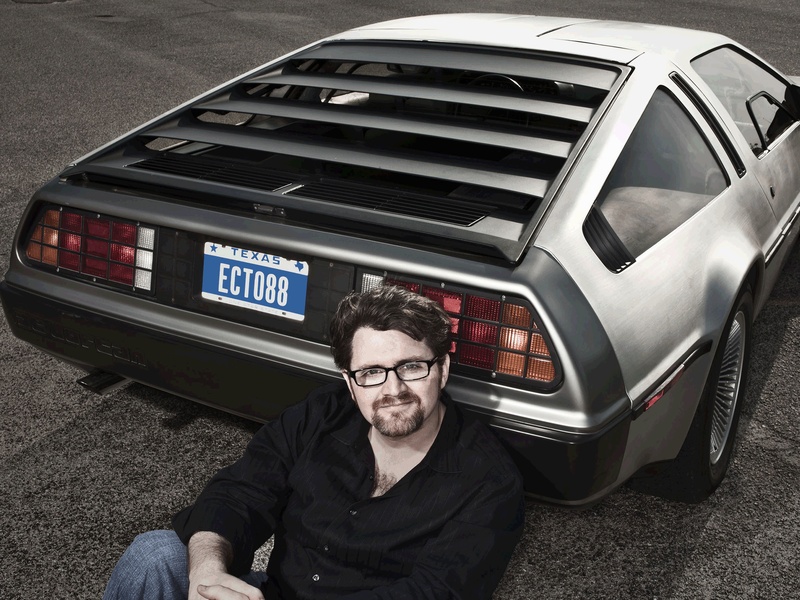
In the interest of full disclosure, this author must admit a serious bias towards the source material. In that I am a massive fan of The Room. I have been to both the RiffTrax version of The Room (in theaters, not live in Nashville) and the unriffed version (here in Memphis) with hundreds of shouting fans. I also bought The Room on Blu-Ray for $36 (it did not just come with the movie but also a draw-string backpack and the T-shirt you see me wearing above), but it was worth in that Tommy Wiseau signed it to me personally; you can request this if you purchase this through his official website. And to top it off, I was able to meet the one-and-only Greg Sestero when he came to town as part of a book festival. He talked about the book, Tommy, making The Room and near the end of his panel, he invited folks to come on stage to read from the original draft of The Room's script. When it came time to offer the role of Johnny, I turned around to see how many hands would go up. None of them did. Nobody was making their way to the stage. I thought, "Screw it. This is truly once-in-a-lifetime." So I went onstage to read Johnny in a shameful Tommy Wiseau impression opposite Greg Sestero. Greg was a true gentleman, very kind and patient. I responded by accidentally saying, "Hi, Mark," instead of his real name. Whoops! Still, the experience was genuinely thrilling. I got to take a picture with him, he signed my Blu-Ray copy of The Room and my hardcover copy of "The Disaster Artist". I think the world of Tommy and Greg and respect their immense talent. They have a new movie coming soon called Best F(r)iends that I am most definitely seeing the first chance I get. 

Tuesday, November 21, 2017

JUSTICE LEAGUE: Identity Crisis

NOTE: Faster than a speeding SPOILERS!


"It's good to see you playing well with others."
"May be temporary."

- Commissioner Gordon (J.K. Simmons) and Batman (Ben Affleck), Justice League (2017)


Outside of the failed Dark Universe, there is perhaps no other cinematic universe that has been tied to Hollywood's whipping post quite like the DC Extended Universe. Starting with 2013's Man of Steel, DC has been trying its damnedest to catch up to the goldmine that is the Marvel Cinematic Universe. Zack Snyder, director of comic book adaptations like 300 and Watchmen, was put in the director's chair and while early trailers seemed promising, the movie did nothing but alienate people from the world's most famous superhero.


And worse was to come. Bringing together DC's two flagship characters as well as the live-action debut of its most famous female superhero should have been nothing short of a movie miracle. They even managed to cast Academy Award winner Ben Affleck, hot off his success with Argo, as the new Batman. Yet Batman v. Superman: Dawn of Justice became a laughingstock of 2016 pop culture; Sad Affleck and "MARTHA?! WHY DID YOU SAY THAT NAME?!" spread across the Internet like wildfire. The salt was directly applied to the wound when Marvel Studios released Captain America: Civil War, another "superheroes fighting" movie, to both fan and critical acclaim. Marvel once again laughed its way to the bank, while DC limped back home with its pants down. DC's second shot in 2016 was the David Ayer film Suicide Squad featuring low rent DC villains (with the exception of Harley Quinn and the Joker) trying to be heroes, but the film was dismissed as a cheap imitation of Marvel Studios' Guardians of the Galaxy.


However, coming into the new year, there was a bright light at the end of the tunnel; the world's first major theatrical live-action female superhero movie directed by a woman. With its proper balance of intriguing drama, thrilling action and well-placed comedy as well as a star-making performance from Gal Gadot, Patty Jenkins' Wonder Woman became a runaway success both at the box office and with critics. Many were drawing positive comparisons to Richard Donner's 1978 Superman, as a seminal superhero film; Donner himself proudly bestowed a literal baton pass to Jenkins at a recent event they both were headlining. DC and Warner Bros. finally had the ball in their corner. All they had to do was make the right shot and pray for a miracle...


Following the death of Superman, Batman/Bruce Wayne (Ben Affleck) - racked with guilt by his part in the actions that led to that event - begins an ambitious plan to bring together an alliance of powerful warriors that can combat an enormous threat coming to Earth. That threat is Steppenwolf (voice of Ciarán Hinds), an alien dictator that is seeking three ancient artifacts that - once connected - will spell the end of the world. Joining Batman is the immortal Amazon warrior princess Wonder Woman/Diana Prince (Gal Gadot), the burly and saracastic Atlantean Aquaman/Arthur Curry (Jason Momoa), the energetic yet untested Flash/Barry Allen (Ezra Miller) and the reclusive Cyborg/Victor Stone (Ray Fisher). All of these heroes will be brought to their limits but, though they are stronger together, they find they may need more help.


It is practically important (and potentially straight dishonest) to talk about this movie without at least touching on its difficult post-production process. Earlier in the year, Warner Bros. and director Zack Snyder jointly announced that he was stepping down from all duties related to Justice League. It was revealed that weeks earlier, one of Snyder's daughters tragically committed suicide and that he and his family needed time to grieve. In a show of uncharacteristic generosity for a major Hollywood studio, Warners agreed that this was best for all involved and wished him nothing but the best. In Snyder's stead, the studio hired Avengers guru Joss Whedon to jump from Marvel to DC (with Kevin Feige's blessing) to take over all post-production duties. Interestingly, Whedon is not credited as director (per DGA rules and a sop to Snyder himself) but he did receive a co-screenwriting credit. Which begs the question: how much Joss Whedon is in this Zack Snyder movie?


What garnered most of the Internet's attention were reshoots Whedon scheduled with the whole cast. While the exact circumstances that prompted the reshoots is still questionable, Justice League began filming weeks after the dismal opening of Batman v. Superman with no time for course-correction. Believing that working with Marvel Studios gave him the magical calculation to making superhero movies work, Warner Bros. moved heaven and earth to give Whedon what he needed. Almost humorously, this involved pulling a contractually-mustachioed Henry Cavill off the set of Mission: Impossible 6 and making painstaking efforts to digitally fix his upper lip. But all of this would be for naught if the movie itself was not received well by the public. And unfortunately for DC, history has a way of repeating itself.


Well, at least to the majority of critics. Rotten Tomatoes, a company owned by Warner Bros., held off from releasing the film's initial percentage scoring until the day of the film's release; a move seen as consciously duplicitous. Rotten Tomatoes, whether people like it or not, has become a popular deciding factor for people to pick and choose what movies are worth their time. Movies have essentially died on the vine if Rotten Tomatoes seemingly says they are not up to snuff. But when it comes to a Warner Bros. property, hiding Justice League's score until the day of release... it shows the company does not hold good vibes for its future.


So after all this, we have finally gotten to my take on the movie (as I am sure you have gathered by now, I rarely subscribe to the "TL;DR" nature of the Internet). And to be perfectly honest, I thought the movie was absolutely 100%... okay. Not great. Not even good. Perfectly fine. Serviceable. Which would not matter if it was just another movie. But this is the Justice League movie; a movie that not even Academy Award winner George Miller (you know, Mad Max, Babe and Happy Feet) was allowed to make. It has all the DC mainstays (without Martian Manhunter and Green Lantern but the Corps is still represented in the movie briefly). This should be even bigger than The Avengers. And it is just not.


The cast is a mixed bag for me. I have never gotten the hate over Ben Affleck's performance as Batman. He is better here than he was in Batman v. Superman but in that movie he was pretty much just a bundle of rage in a Batman costume. Here he actually plays the Dark Knight in a way that just feels right. Gal Gadot returns for her role as Diana and she brings back that sense of genuine care and good-naturedness that makes her character likable. The newcomers are a bit of different story. I did not care for Ezra Miller in Fantastic Beasts and Where to Find Them. He is better here than he was in that film, but I could not muster goodwill for his take on The Flash. Jason Momoa plays Aquaman as the drunken badass of the group but that pretty much sums up his character. We get the feeling that he is resentful of his place in the world as someone who is half human. But that is not fleshed out in any way. Ray Fisher gets the short end of the stick as Cyborg - why he is in the Justice League as opposed to the Teen Titans is beyond me. He broods mostly and does not lighten up for anything. Even his trademark "Boo-ya" seems off.


Danny Elfman is the composer of this movie and he certainly is no stranger to superhero movies. He's composed scores for Spider-Man, Hulk and even Avengers: Age of Ultron for Joss Whedon. Most notably however is his theme for the 1989 Batman. When asked if he was going to come up with a theme befitting Ben Affleck's Batman, Elfman refused saying his theme personified Batman perfectly. However, Elfman also chose to bring back John Williams' classic Superman theme that was conducted for the 1978 Richard Donner film. Herein lies the problem: it is not that noticeable within the film itself unless you were actively hearing for it like I was. It can be heard, but themes that are that memorable call for memorable moments not just background nostalgia.


In most good superhero movies, there is almost always an inspiring speech that either the hero gives themselves or a loved one gives the hero. Something that sums up why they are the good guy, why it is important and why they should keep going. I can think of a few examples off the top of my head - Aunt May's "I believe there's a hero in all of us" from Spider-Man 2, Peter Quill's "Life takes more than it gives" from Guardians of the Galaxy and Nick Fury's "A group of remarkable people" from Marvel's The Avengers. Now where is this speech in Justice League? Just before their first battle against Steppenwolf where he is holding humans hostage, the Flash takes Batman aside and fearfully admits he has never actually done battle. Batman breaks it down for him,

"Save one. Save one person. Don't talk, don't fight. Get in, get one out."

I like how Batman breaks down the minutiae of supehero-ing to its core component: helping other people at risk to yourself. This could have been, should have been, a seminal moment for the movie. While it certainly seems to bolster Flash's courage in the following scene and in the rest of the movie, a more memorable signature moment would have been more appreciated.


If there is any improvement on any single returning character from the DCEU, it would have to be Superman, who is brought back from the dead by the Justice League in the second act. This is Henry Cavill's third run at this iconic character. And in this case, the third time might be the charm. At first, Superman is angry and confused; seemingly without his memory. Batman brings Lois Lane (Amy Adams) to him so she can help bring him back to himself. But naturally, the good old Superman we know comes in at the last minute to help save the day. He is smiling, cracking jokes and bringing his formidable powers to bear to help his fellow team members and civilians. This is as close to the Christopher Reeve Superman as we have gotten in quite a good long while; I do not count Superman III, IV and Returns (who would have guessed Kevin Spacey would have turned out to be a bigger villain than Lex Luthor). As long as Cavill is allowed to stay in this mode of Superman and not be the Big Brooding Boy Scout, I'll be glad to see Man of Steel 2. If it ever gets made.


DC's Justice League is not so much a misfire as it is a missed opportunity; an injustice if you will (be sure to tip your waitresses). The cast mostly plays well together, but the playground they are given could use some upkeep and maintenance. Trying to fix the mistake that is Batman v. Superman resulted in efforts too little, too late. I am not saying that the DCEU is beyond saving - Wonder Woman proved this - but it needs to be done quickly and smartly. I really like these characters and the comic book universe they reside in. It just needs more people who are willing to give the time and care they deserve to bring them to the silver screen.

P.S. Stay for the full end credits.