- Robert Zemeckis' Yellow Submarine

In 2008, Robert Zemeckis and Walt Disney Pictures signed an agreement to house performance capture production company ImageMovers Digital. The deal, headed by then-studio head Dick Cook, was bringing the Academy Award-winning director and his new favorite filmmaking technology to the Mouse House. In three years, the studio released two films, Disney's A Christmas Carol and Mars Needs Moms, with a third in development. However, Mars Needs Moms bombed so badly that Disney immediately disowned ImageMovers leaving a distraught Zemeckis to return to live-action filmmaking with Flight and The Walk.

The decision left behind the unmade 3D remake of The Beatles' Yellow Submarine. At the time, it was considered that a combination of Disney, the Beatles and Zemeckis would be irresistible. Zemeckis, himself a Beatles fan, began his directing career with a love letter to the Fab Four, I Wanna Hold Your Hand. It was so far in development that it was already being previewed at the first ever D23 fan convention (where the title treatment image was taken) and casting was already underway including Cary Elwes (Disney's A Christmas Carol) as George Harrison and Peter Serafinowicz (Shaun of the Dead). The Tenth Doctor himself, David Tennant, had auditioned for the film's chief villain - the Blue Meanie. Appearances by Paul McCartney and Ringo Starr, the two remaining Beatles, were being planned but like the rest of the project, never transpired.


NOTE: The above image comes from "The Beatles: Rock Band".
The decision left behind the unmade 3D remake of The Beatles' Yellow Submarine. At the time, it was considered that a combination of Disney, the Beatles and Zemeckis would be irresistible. Zemeckis, himself a Beatles fan, began his directing career with a love letter to the Fab Four, I Wanna Hold Your Hand. It was so far in development that it was already being previewed at the first ever D23 fan convention (where the title treatment image was taken) and casting was already underway including Cary Elwes (Disney's A Christmas Carol) as George Harrison and Peter Serafinowicz (Shaun of the Dead). The Tenth Doctor himself, David Tennant, had auditioned for the film's chief villain - the Blue Meanie. Appearances by Paul McCartney and Ringo Starr, the two remaining Beatles, were being planned but like the rest of the project, never transpired.

"That would have been a great one to bring the Beatles back to life. But it’s probably better not to be remade – you’re always behind the 8-ball when [you do] a remake. It gets harder and harder [to make movies]. With the current state of the industry, it’s difficult to stay passionate about it. The hardest thing for a filmmaker as he’s aging is saying, 'How much more of this crap can I take?' It’s tough, I can only do it if I have a script to believe in."
- Robert Zemeckis
Likelihood (to ever be made): Never.
- Frank Oz's The Cheapest Muppet Movie Ever Made


Oz hadn't worked with the Muppets extensively since The Muppet Christmas Carol; his Muppet roles for Muppet Treasure Island and Muppets in Space were all done with Oz contributing the voice for said characters in post-production. Working Muppeteer Eric Jacobson has since taken over for most of the Oz characters. Once Disney purchased the film rights to the Muppets, studio executive Dick Cook went to Frank Oz about making the film Jim Henson left behind. Though it was familiar territory in more ways than one, Oz was intrigued and spent a few weeks going over the script and building a preliminary budget. He presented the budget plan to Dick Cook and it's $40 million and Cook nearly has a heart attack. "It's The Cheapest Muppet Movie Ever Made," he complained. "I was thinking like $15 million?" Oz looks Cook dead in the eye and says deadpan, "Do you understand how much money it takes to make things look cheap?" So Oz was let go and Jason Segal was allowed in. Frank Oz's last directorial film in theaters was the British comedy, Death at a Funeral (which was later remade in America with Chris Rock, Martin Lawrence and Tracy Morgan in the leads) and he continues to work in TV. The Muppets finally made it in theaters in 2011 to $165 million worldwide which leads to the Segal-less sequel, Muppets Most Wanted, three years later which grosses less than half of that worldwide.
Likelihood: Probably never
- Richard Donner's Crazy Taxi

In probably one of the most weird combinations of directors and material, filmmaker Richard Donner (The Omen, Superman: The Movie, The Goonies, Scrooged and the Lethal Weapon movies) was approached about creating a movie based on the hysterical video game "Crazy Taxi". In the game, you take on one of four wacky drivers who will literally do anything - legal or illegal - to get their clients to their destination on time. Players fell in love with its insane gameplay without any consequences from police or other authority figures, the often irascible customers who will jump out of the car if you are late to their destination and the inimitable soundtrack exclusively featuring the bands The Offspring and Bad Religion.

Somehow, a game controller connected to "Crazy Taxi" wound up in the hands of Richard Donner. He played the game and loved it. SEGA was even prepared to redefine their franchise by what Donner and crew would create with the new film, though Donner downplayed any ideas of sequels before the first film had even been released (an oddity 10 years ago, a near impossibility today). Unfortunately, by the time Donner was able to tear himself away from the game and sit down with potential writers, it was determined that there was no real way to create enough of a plot to satisfy both gamers and moviegoers. SEGA had to watch as Donner removed himself from the project, effectively killing it. They were, however, out of the line of fire as the next decade of filmmaking could not save video game movies like Doom, Prince of Persia: The Sands of Time, Max Payne, two different Hitman movies and most recently, Assassin's Creed and Rampage. Next year will be the time SEGA finally jumps to the big-screen with their flagship character Sonic the Hedgehog, who has previously made appearances in Wreck-It Ralph and Ready Player One. Will fortune smile upon the Blue Blur? Time will tell, but Crazy Taxi stalled out in first gear.
"I plan on doing a lot of experimentation with this film, trying things no one's really played around with, to really put the audience in the front or back seat of the taxi during the action sequences. You can do a lot more with the camera work in a movie to make the action sequences feel like those in the game. While a lot of video games are set in science-fiction environments or fantasy worlds, Crazy Taxi is set in New York City with a Russian cab driver. If you do this right, it'll be a lot of fun."
- Richard Donner
Likelihood: Never.
- Brad Bird's 1906

Two-time Academy Award winner Brad Bird is one of the film community's most beloved storytellers. Starting with the immortal tearjerker The Iron Giant and rounding out with the recently released Incredibles 2, Bird has proven himself to be a capable filmmaker with almost anything you put in front of him (Tomorrowland notwithstanding). However, there is one project that has continually eluded him - an epic drama adventure based on a book called 1906.

The film, a retelling of the tragic 1906 San Francisco earthquake, was being developed by Warner Bros. Pictures in the hopes of replicating another Titanic by including a love story in the midst of chaos. Following completion of Ratatouille, Bird signed on to direct and rewrite the screenplay written by the book's author. To alleviate fears of an escalating budget, an unusual contract was put into place for the film to be a co-production between Warner Bros., Walt Disney Pictures and Pixar. The Shelby Forthright sequences of WALL-E are rumored to have been a test for Pixar to try out live-action filmmaking for both Bird and future John Carter director Andrew Stanton. However, the fact that Brad Bird had never directed a live-action film before continued to stick with Warner Bros. and they were reluctant to commit potential hundreds of millions toward a "cartoon" guy.

Hope came in the form of J.J. Abrams, who texted Bird with one word: "Mission?". A two-year journey began for the Incredibles filmmaker to finally make the jump from animation to live-action with the 2011 film Mission: Impossible - Ghost Protocol. The film quickly became not only the highest grossing film in the series but the most critically acclaimed as well. Bird proudly came back to the Warner Bros. lot, expecting the executives to be suitably impressed. Apparently not, as Bird was told, "You directed the fourth installment of a film franchise based on a television series starring the most recognizable movie star in the world. What else ya got?" Bird was incensed, but began looking for another bankable project. Then, Tomorrowland happened. All this time, Brad has been the sole cheerleader for 1906 - even recently, on the press tour for Incredibles 2 he was quoted as saying that the project was not dead and may use the plan that Dark Tower abandoned: an intertwining media project of a TV miniseries culminating in a feature film for the actual earthquake. If cameras began rolling tomorrow, they would do so without the participation of Disney; with Marvel and Lucasfilm, they have bigger fish to fry. It seems that for now, all of Bird's men may not be able to put 1906 back together again.
“At (that) time, Chinatown was coexisting with the Barbary Coast, which was like the Wild Wild West, and at the same time Nob Hill had the upper class. It was a time between two centuries. You had horses and cars existing simultaneously. It’s just a volatile mix of things and then you throw in an earthquake. I mean, come on, if that doesn’t buy popcorn …”
- Brad Bird
Likelihood: May still happen.
- Terry Gilliam's Son of Strangelove

I have made no secret that my favorite of the films directed by Stanley Kubrick is his sole comedy, the witty war film Dr. Strangelove or: How I Learned to Stop Worrying and Love the Bomb. It is hysterically funny, showcasing the last people we would ever want in charge if the nuclear bombs were going to fall. The incomparable Peter Sellers delivers not one, not two but three landmark performances and even has two of them carry on conversations with each other. Though one must not ignore the amazing work of George C. Scott as General Buck Turgidson, who literally trips himself up without breaking character in one of my all-time favorite shots of cinema. In his career, Stanley Kubrick never made a sequel to any of his other films; though a sequel to his Strangelove follow-up, 2001: A Space Odyssey (recently re-released in IMAX and it was breathtaking), was made without his cooperation. Such a concept seemed beyond a master like Kubrick. But almost 20 years after his death, the master is still taking us back to school.
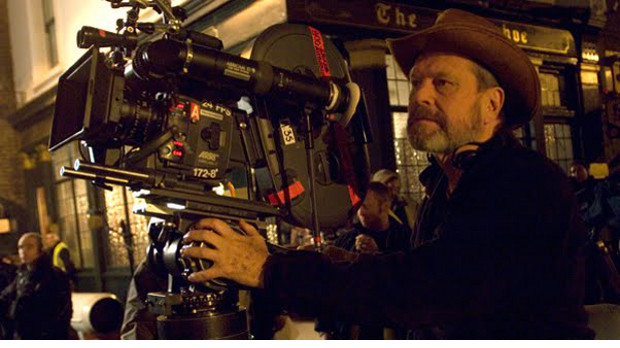
A sequel to Strangelove is a tale of two Terrys - Terry Southern, one of the co-writers of Dr. Strangelove and Terry Gilliam, famed Monty Python comedian and director of such films as The Fisher King, 12 Monkeys and Fear and Loathing in Las Vegas. After the death of Southern in 1995, his family donated boxes upon boxes of his literary work to the New York Public Library where it was recently discovered treatments for a film titled Son of Strangelove. Other potential sequel titles included Turgidson's Mother or: Into the Shaft! and Muffley Strikes Back. As Strangelove ends with the end of the world via the Doomsday Machine, the film would have followed through with Strangelove's mad plan to repopulate the world in mine shafts, with "10 females to each male". No word if Dimitri got to make it into the shaft with his poached eggs. Kubrick apparently approved the development of the film and chose Terry Gilliam to direct it, feeling he had the right sensibilities. There was just one problem: Gilliam did not know about the project himself until over a decade after the passing of both Kubrick and Southern. Gilliam said he would have most definitely taken on the project. My only question is who on Earth would have been able to follow in the footsteps of Peter Sellers? Steve Martin tried it with his two Pink Panther films and they went nowhere. I think it's best to leave Dr. Strangelove forever in the War Room, where it can walk into immortality.
And that's just five of the projects that never ever got off the ground. Should they have? Are there more you'd like to hear about? Let me know in the comments!